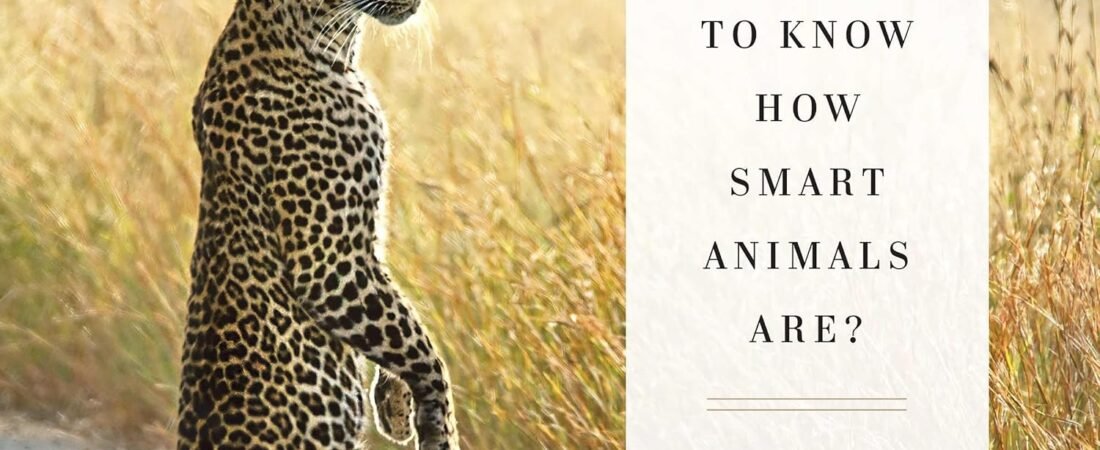
Are We Smart Enough to Know How Smart Animals Are?
Frans de Waal | W. W. Norton & Company | 2016
⭐⭐⭐⭐⭐ (5/5)
Are We Smart Enough to Know How Smart Animals Are? Frans de Waal doesn’t ask his title question ironically. Moreover, he means it seriously, and by the time you reach the pages of this remarkable book, you will too.
De Waal, one of the world’s foremost primatologists, spent decades watching animals think. They were not simply performing tasks or responding to stimuli. Moreover, they were actually thinking, planning, remembering, deceiving, and empathizing. They were solving problems in ways our scientific frameworks could not recognize. This book is his case for a complete rethinking of how we study and understand animal minds.
The Problem with Human Exceptionalism
The central argument of the book is elegantly simple. It states that for most of the twentieth century, scientists studying animal behaviour looked for the wrong things. They designed tests based on human benchmarks. These tests asked whether animals could pass tasks that humans had devised. They occurred in environments humans had constructed and were rewarded in ways humans understood. When animals failed, the conclusion was that they lacked the relevant cognitive capacity. Moreover, De Waal’s counter-argument is devastating: the tests themselves were the problem.
A chimpanzee tested on short-term memory in a laboratory setting may outperform humans.A crow may plan for tomorrow by hiding food it won’t need until the following day. An octopus may recognize individual human faces and respond differently to keepers it likes.It may also react differently to keepers it doesn’t. None of these abilities fit neatly into traditional frameworks. However, they are unambiguously intelligent behaviour, adapted to the specific ecological demands of each species.
The Animal Examples That Stay With You
Moreover, they linger in memory. What makes this book exceptional is the specificity of its examples. De Waal doesn’t deal in vague generalizations about animal cleverness rather he takes you into the research, species by species, experiment by experiment.
Ayumu, a young chimpanzee at Kyoto University, can memorize the position of numbers on a screen in a fraction of a second a task that defeats almost every human who attempts it. New Caledonian crows fashion tools from materials they have never encountered before, solving multi-step problems that require genuine forward planning. Elephants classify humans by age, gender, and even language hence distinguishing between different Kenyan ethnic groups by the colour and smell of their clothing. And octopuses, those famously alien intelligences, use coconut shells as portable shelters — tool use in an animal whose lineage diverged from ours over 500 million years ago.
Each example lands differently. The cumulative effect is one of the most powerful arguments in popular science for the proposition that intelligence is not a single thing that animals either have or lack — it is a diverse, evolved, species-specific capacity shaped by ecological pressures we are only beginning to understand.
Why This Book Matters Beyond the Science
As someone who works at the interface of wildlife and domestic animal health, I read this book with a particular kind of recognition. The animals de Waal describes are not performing for us. They are living in worlds of their own worlds with their own logic, their own demands, their own solutions. The failure to recognize this has cost us enormously, both scientifically and ethically.
De Waal is not sentimental about this. He is rigorous, precise, and at times sharply critical of the anthropocentrism embedded in behavioural science. But the book never loses its sense of wonder. These are extraordinary creatures. We are finally, slowly, beginning to see them clearly.
A Warning About the Title
One small notice : the title, while memorable, slightly oversells the book’s accessibility. This is not a light popular science read — de Waal is writing for an engaged, intellectually curious audience, and some sections assume familiarity with behavioural ecology concepts. Readers entirely new to the field may find certain passages dense. But persevere. The rewards are substantial.
Recommended for: Wildlife biologists, behavioural ecologists, anyone who has ever watched an animal solve a problem and suspected there was more going on than instinct. Essential reading.
Get the book: Are We Smart Enough to Know How Smart Animals Are? on Amazon
Affiliate Disclosure: This post contains affiliate links. If you purchase through my link, I may earn a small commission at no extra cost to you. See my full Affiliate Disclosure for details.